

Police use of live facial recognition (LFR) is rarely out of the headlines. In the last few months alone, we’ve seen the Home Office roll out 10 LFR vans to 7 new forces, the Met attract controversy for deploying LFR at Notting Hill Carnival for the first time since 2017, and the Government announce plans for a whole new legal framework. This all follows a decade of LFR use in which it has been deployed over 600 times.
Our new report, ‘Live Facial Recognition: The Case for Coordinated National Expansion’, is authored by Senior Consultant James Sweetland. It takes you to the heart of the fast-moving story around this policing tool.
Drawing on interviews with senior police leaders (including the NPCC lead for FR and the Police Chief Scientific Adviser), exclusive analysis of LFR deployment data, and a foreword from the Met Police Commissioner, it sets out why this is a defining moment for LFR and why the time has come for a national coordination capability.
In this short blog, we give you a preview of the key features of this thought-provoking new report.
Four key insights
1. Exclusive analysis of a decade of published LFR deployment data
Leapwise has collated and analysed published LFR deployment from forces across England and Wales, covering the period from June 2015 to September 2025. We found that:
- LFR has been deployed 613 times since 2015 – with 463 (76%) of total deployments taking place in 2024 and 2025 alone.
- LFR has scanned 13.3 million faces since 2015 – with the biometrics of those who are not wanted immediately and permanently deleted.
- Police have taken enforcement action (arrests, cautions and other action) 2,655 times following LFR alerts, including 1,343 arrests by the Metropolitan Police alone.
- 2025 is now the second year running in which LFR has resulted in enforcement action over 1,000 times in a calendar year.
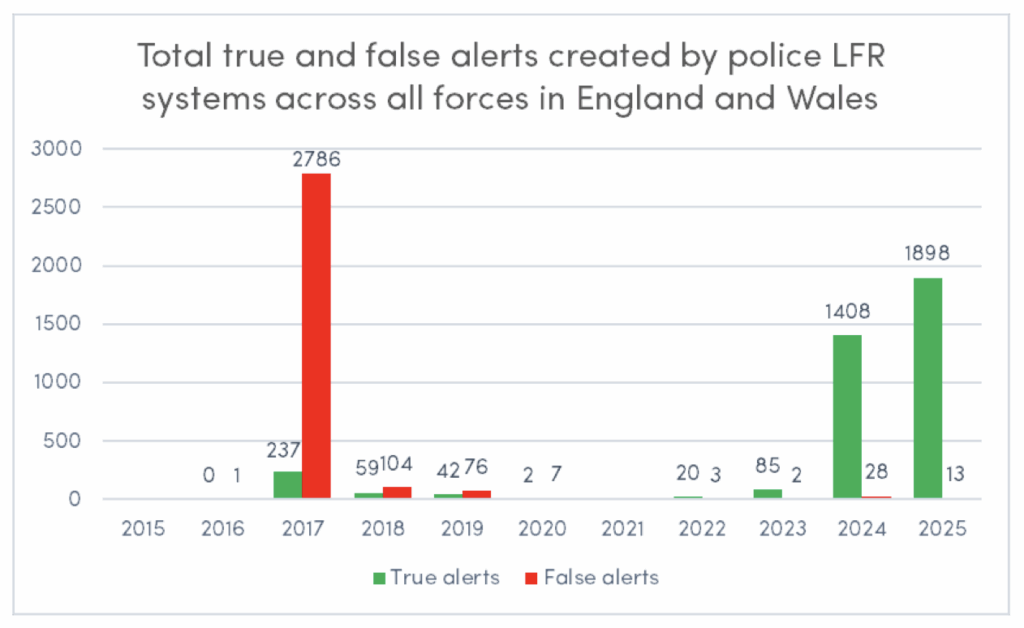
- There were 1,408 true alerts from police LFR systems (vs 28 false ones) in 2024 and 1,898 true alerts with just 13 false ones in 2025.
- There’s much more than this in the report itself. That includes year-by-year data on key LFR statistics (see Figure 11 from the paper below).
2. Insight into why this is the ‘defining moment’ for police use of LFR
Our report also tells the story of how LFR has developed as a policing tool, led by two pioneering forces (the Met and South Wales Police) in particular. Through effective national leadership and close collaboration, they have developed a strong base of best practice that has complemented improvements to the underlying technology.
But the Home Office rollout of LFR to a further seven forces means that a close-knit, standardised approach is under threat. As Figure 7 from the report (see below) shows, the ‘new leader’ forces outnumber the pioneers. There are now thrice as many forces with their own LFR capabilities when compared to just a few months ago.
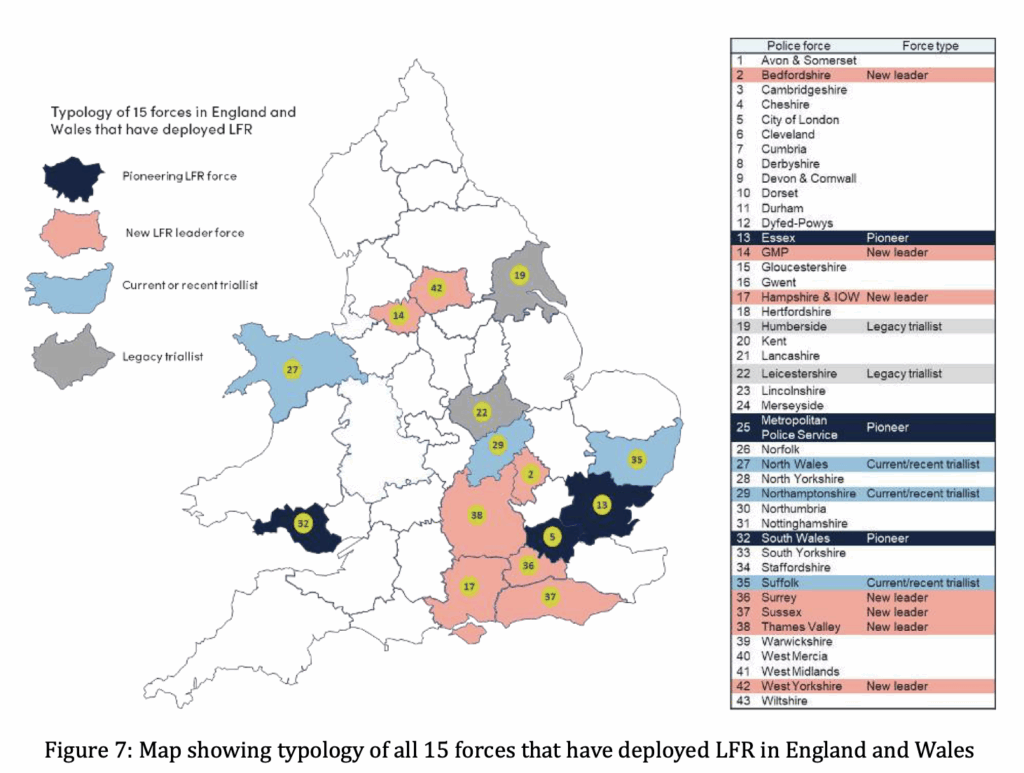
What does that mean? National leaders can no longer keep such a tight rein on LFR practice. While new forces may well innovate effectively, there is also a greater chance for wasteful duplication, poor practice, or mistakes that will yield lawsuits, negative press, and poorer outcomes. It’s for this reason that a stronger coordination model is needed at the centre.
3. Views from Met Commissioner Sir Mark Rowley
Our Senior Consultant James Sweetland makes that case in detail throughout the paper. He argues national coordination is needed and it’s needed now, in the face of this ‘defining moment.’ The report’s foreword – written by the Commissioner of the Metropolitan Police – also endorses this case.
Sir Mark writes: “But as LFR is rolled out to more forces across England and Wales, we must ensure that its use is consistent and effective everywhere. That means moving beyond local innovation to a national model of coordination. This is why I support police reform that enables the proper, once-and-for-all rollout of technology like LFR.”
“Reform is not just about new tools. It is about building the infrastructure, clarity, and professional standards that allow technology to strengthen, magnify, and enable what our determined, compassionate, and often heroic officers do for our communities. Technology gives officers more time and better situational awareness, so they can do what only humans can do: listen, support, prevent crime, and bring offenders to justice.”
4. A blueprint for a new national coordination capability
In line with Sir Mark’s argument, our paper then presents a blueprint for what this new national coordination capability should look like – with four key elements:
- National control – a stronger centre, headed by a full-time police lead for police biometrics (including LFR), with responsibility for key support services like procurement, developing training packages, and algorithmic testing that shouldn’t be done 43 times across England and Wales.
- National coordination with locally delivered activities – national development of LFR best practice, collation of deployment statistics, R&D functions, and research commissioning, but with all these capabilities relying on local activity.
- Local autonomy and responsibility – local autonomy over which (if any) nationally-identified LFR solutions to deploy, where, and in what circumstances, watchlist composition (within some reasonable limits), and community engagement activities.
- Legal certainty – a single legal framework for police biometrics, including LFR, developed by the end of this Parliament.
Read the full report today
You can now read the full report on our website here. That includes all our exclusive analysis of LFR deployment data and the detailed policy recommendations we set out for a new national LFR coordination capability.
If you’re interested in learning more about LFR, navigating the world of police technology, or speaking with the author directly for further insight, you can reach our team by clicking the button below.