
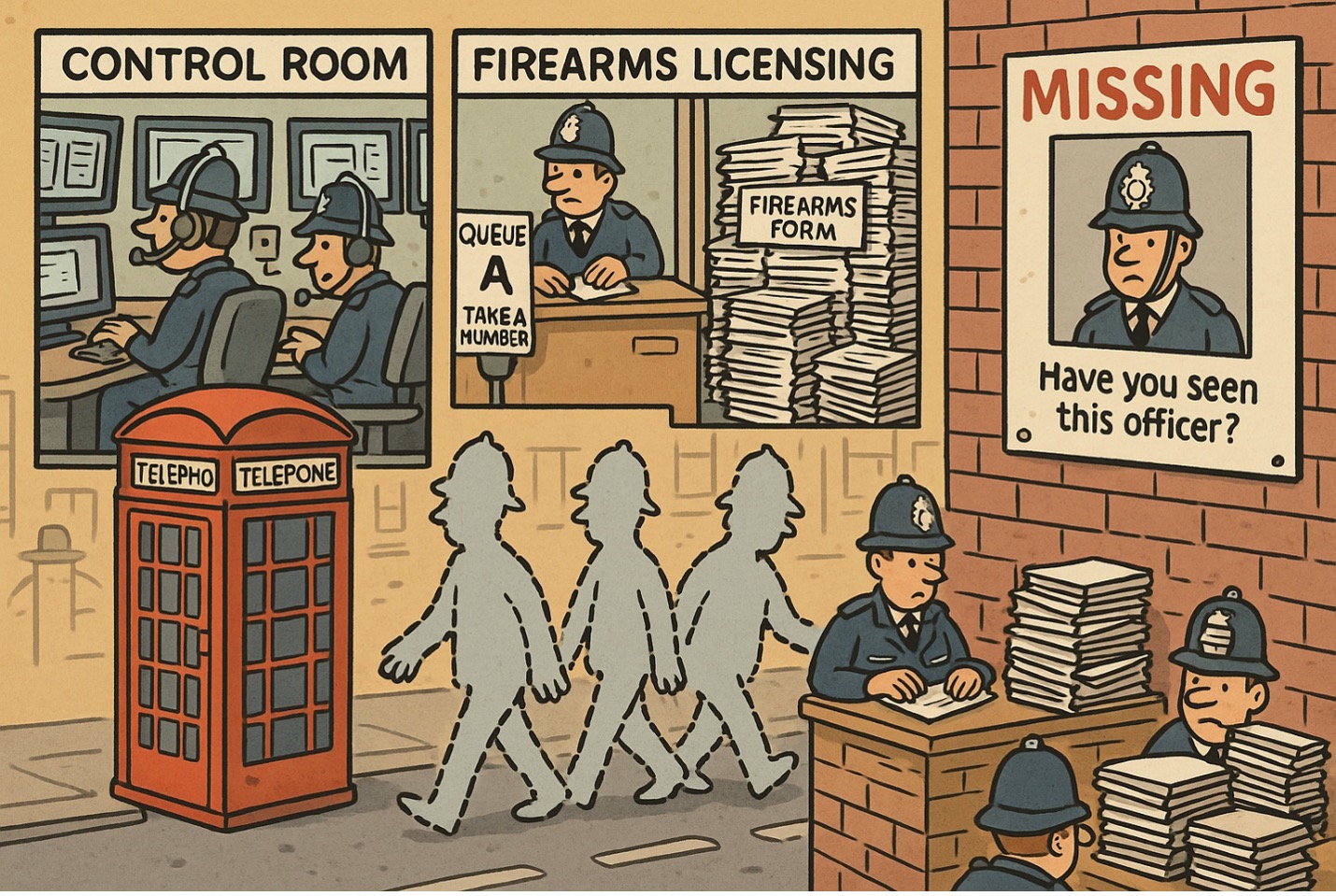
Hiring 20,000 more police officers does not translate to having 20,000 more coppers serving on our streets. This was the lesson in the first blog in this series, which showed that an increasing proportion ofwarranted officers have been going into support services every year since the Police Uplift Programme began.
In this second blog in that series, we show:
- How the trend we saw in support services appears to be occurring in other places too, like Central Communications Units (CCUs)
- How national-level reforms could help force leaders get officers back onto the streets, as the Uplift programme promised
- What local forces can do (while they wait for national reforms) to get officers back onto the frontline
How the shape of police staffing is changing
To understand where new officers are heading, we use the Police Objective Analysis (see full details in our first blog) which defines four types of role:
- Visible frontline – the ‘bobbies on the beat’ Uplift was supposed to deliver
- Non-visible frontline – people delivering a direct service to the public but who aren’t usually seen out and about in uniform (e.g. people working in CCUs)
- Frontline support – personnel like forensics experts who assist frontline officers
- Business support – personnel in HR, estates, finance or related roles who perform crucial functions that you see in other large organisations
Our last blog shows that the proportion of officers within this last category had risen from 22% FTE in March 2018 to over 27% by 2024. This is the most direct way a force could shunt officers into an ‘office job.’ HR, estates, or finance roles are essential, but they don’t require a warrant card to be done well.
CCUs: more officers – at what cost?
Moving officers into non-visible frontline roles is another way that ‘new’ officers could end up off the streets. An example of this is placing warranted officers into CCUs. It’s easy to imagine advantages of this: their experience of the situations that are likely to be unfolding on the other end of the phone could actually make them excellent call handlers.
However, there are costs too. Police staff often have years of experience answering the phone in a CCU, so they have developing skills that frontline officers naturally haven’t. Furthermore, it means that frontline officers aren’t using their specific powers: you’re unlikely to arrest someone from the control room. And, in financially stretched times for police forces, there’s the basic reality that officers are more expensive than police staff – so a higher proportion of the former will mean higher overall costs.
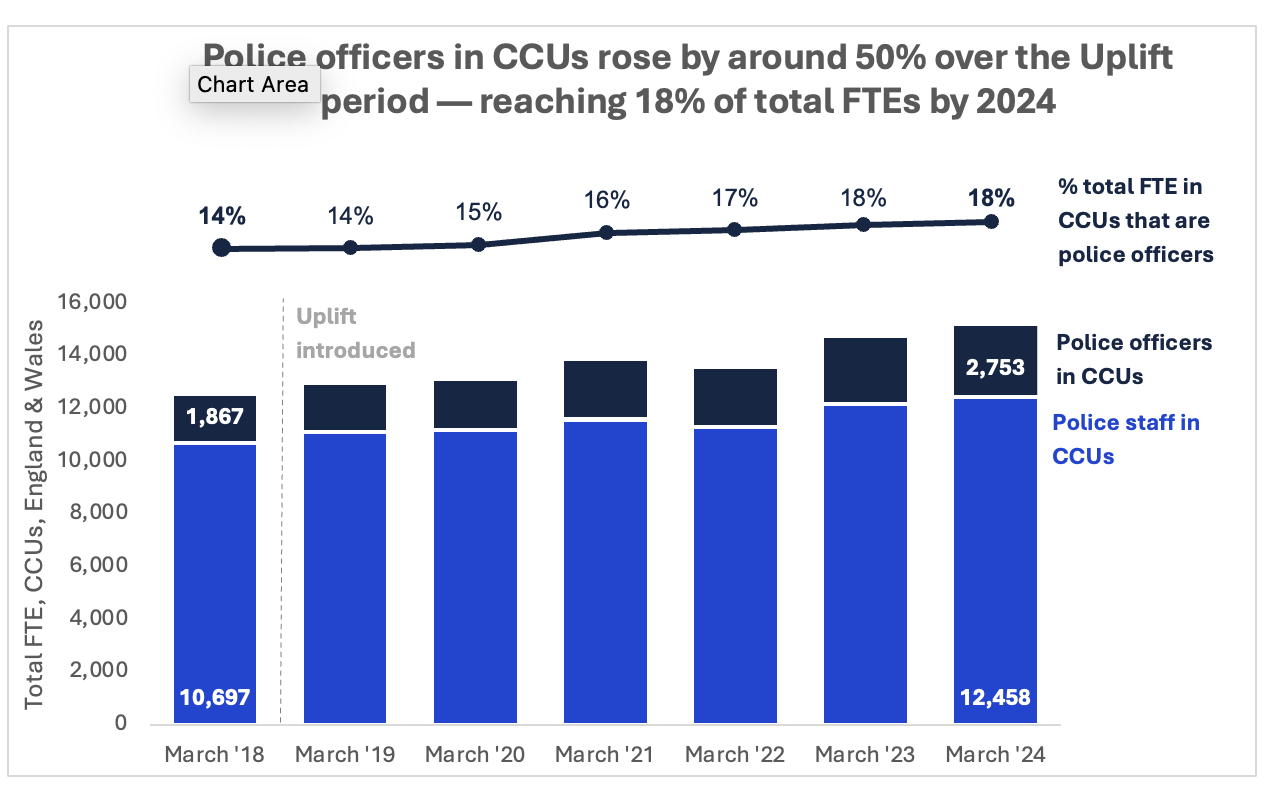
Our analysis shows that there has been a rebalancing of the CCU workforce post-Uplift towards more officers. The number of police officer FTEs in those units rose by almost 2,000 between 2018 and 2024 across England and Wales, equivalent to officers growing from 14% to 18% of the staffing mix in this period.
Using our estimated figures for officer and staff costs, this implies an additional £11m for staffing CCUs per year across England & Wales, compared to a situation in which pre-Uplift staff-to-officer ratios were maintained.
Staff rebalancing: the wider picture
But CCUs aren’t the only example. Similar trends can also be seen within criminal justice and specialist community liaison, a part of policing including functions such as firearms and liquor licensing. In both areas, the percentage increase in the proportion of officers is even greater than that seen in support services or the CCUs.
| Mid- and back-office functions (% FTE staffed by police officers) | |||
| Policing area | 2018 FTE | 2024 FTE | Increase |
| Specialist community liaison | 67% | 75% | 8% |
| Criminal justice | 6% | 13% | 7% |
| Support functions | 23% | 27% | 4% |
| Central communications unit | 14% | 18% | 4% |
By our calculation, the cost of this rebalancing across these four areas of policing is significant (see table below). Together, it’s around £55m per year when compared to sticking with the 2018 staff-to-officer ratios. To put that in perspective, it’s approximately 25% of the annual budget of Norfolk Constabulary.
| Annual cost of changing workforce mix in mid and back-office functions | |||
| Policing area | 2024 FTE | Increase | Annual cost increase |
| Specialist community liaison | 75% | 8% | £8m |
| Criminal justice | 13% | 7% | £7m |
| Support functions | 27% | 4% | £28m |
| Central communications unit | 18% | 4% | £11m |
National answers
While removing the officer threshold ratios introduced by the PUP would give force leaders more freedom, it’s unlikely to happen. Voters elected a government in 2019 which stood pledging to deliver more officers. And the new Government hasn’t deviated at all: the neighbourhood policing guarantee operates under exactly the same logic.
So, alternative solutions are likely to be needed. One approach would be a new term – ‘crimefighters’ – which aims to avoid the officer/staff distinction. This idea was explored in our recent reform paper published with The Police Foundation.
In essence, ‘crimefighters’ would include police staff who make a direct operational impact for forces. Although many will feel this still inadequately respects the role all police staff play in supporting public outcomes, it would buy leaders more room for manoeuvre than they have now. Another idea, to redraw the boundaries around ‘frontline’ vs ‘non-frontline’ roles, brings the same benefits, but with similar shortcomings.
Local solutions
Even in the challenging financial context policing currently faces, there is room for optimism. In our work with forces, we are consistently finding opportunities to drive real productivity gains, especially within support functions. But it isn’t easy. For the most exciting opportunities we’ve been working on, an ‘invest to save’ approach has been required, with genuine improvements requiring brave bets on skills or technology improvements.
For those that can find the cash for such investments, we believe there are big opportunities to release officers from support functions and get them back out in operational roles. If extra cash isn’t forthcoming from the centre, then these kinds of creative solutions will be essential to drive improvements for the public.
Has your force found new ways to increase productivity or maybe you’re actively searching for new solutions? If so, get in touch with our team at the button below.