

We have written before about the growing imbalance in the policing workforce. Under the Police Uplift Programme, forces have been pushed towards staffing models that prioritise officer numbers over effectiveness, flexibility, and value for money.
Our earlier analysis showed that this shift has already created at least a £55m annual cost through inefficient deployment of officers into roles that could be delivered more effectively by police staff or technology. But that figure is almost certainly an underestimate.
In fact, there are four reasons why the true cost of the current model is even higher than that. Continuing on this path risks locking policing into a cycle of rising costs, constrained innovation, and stagnant productivity. Taken together, they suggest the problem is not simply one of workforce mix, but of a funding strategy that systematically discourages the most sustainable models of service delivery.
4 reasons why the funding model needs to change
- An officer-headcount based funding strategy inhibits innovative models of service delivery. By focusing on officer numbers alone, Uplift drove ‘reverse-civilianisation’ – with officers filling roles previously performed (usually as well or better) by cheaper police staff. By comparing the 2018 (pre-Uplift) and 2024 (post-Uplift) cost of staffing key areas of policing, we estimate this is costing policing at least £55m per annum and rising. A sustainable delivery model should instead involve a balanced funding strategy between officers, staff, technology and innovation.
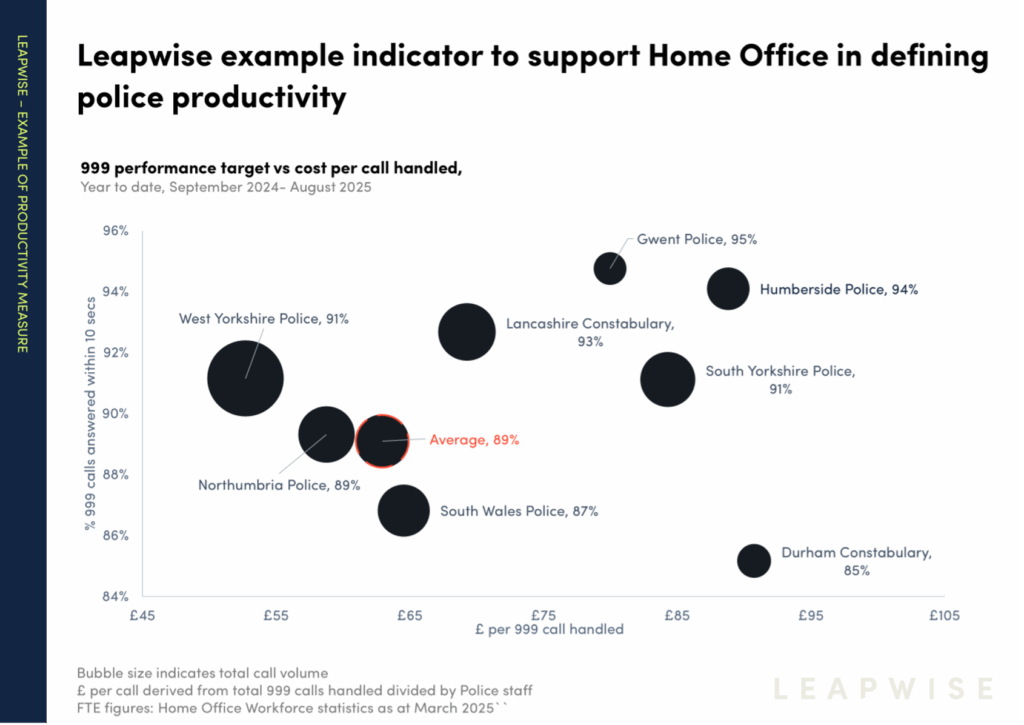
- The absence of measures makes it difficult to incentivise productivity improvement. As highlighted in the National Audit Office’s report, the lack of agreed Home Office productivity definitions makes it harder to assess and reward productivity. While not deliberate, we believe that this allows declining productivity under the funding strategy described above to be hidden. Developing effective comparative measures of police productivity is technically challenging and requires improvements in police data infrastructure, but it can be powerful. Our example analysis (see image below) comparing the ‘unit cost’ of 999 calls with the control room ‘performance’ is crude, but it shows how simple comparisons can spark questions and shift focus towards value for money.
- Policing invests £102m less in productivity initiatives relative to the NHS. As a proportion of total spend, the productivity initiatives funded by the 2024 Spring Statement represent 1.2% of total policing expenditure for FY 2024-5 compared with 1.8% for the equivalent funding made available for the NHS. For policing, this is the difference between investing £230m into innovation versus £332m, a gap of around £102m. Over time, this is likely to limit the capacity of policing to improve productivity and respond to new and emerging crime types.
- A people-intensive policing model is financially unsustainable. 77% of police funding is committed to workforce pay versus 49.2% for the NHS. Good policing depends on having skilled staff and excellent face-to-face service delivery. However, relying on labour alone makes life harder for police forces. It reflects historic under-investment in digital and physical infrastructure (e.g. facial recognition, automation capabilities, appropriately located custody facilities). Dependence on labour exposes any sector to declining value for money, as it creates pressure to increase wages to remain competitive, regardless of whether or not productivity has improved.
Where do we go from here?
Ultimately, national change is required to enable forces to spend and innovate more freely. It’s true that genuinely radical options here could lead to a politically toxic divergence in service levels across the country, in the name of greater experimentation.
However, forces can take steps to improve productivity even without national changes. They can do this by starting to measure productivity through benchmarking:
- Force leaders can benchmark performance internally. We have seen great conversations started by comparing performance within forces across a range of policing areas. For example, a comparison of ‘airlock’ times across custody suites could prompt good discussion about process effectiveness within your force. Internal benchmarking comes with the added benefit of context. It’s easier to be vigilant about external factors when you’re closer to the problem or service you’re measuring. Of course, this does introduce the ‘marking your own homework’ problem, which is where external colleagues or forces can help provide a more objective view.
- Forces can benchmark against similar forces by sharing data with a small handful of colleagues. This keeps most of the benefit of controlling for context, whilst bringing greater scope to gather outside ideas. Activity-level data (such as time to produce case files for given crime types) can be insightful, so long as appropriate steps are taken to control data quality.
Leapwise works with dozens of police forces across England and Wales on performance improvements. If you want to learn more about our work and how we can help your organisation, get in touch by clicking the link below.